
APM Iberian Horses, Lusitano and PRE breeders in northern Spain with 24 years of experience, explains the real advantages of buying a 4-year-old Iberian horse, how to develop it correctly for Dressage or Working Equitation, and what bloodlines to look for.
Buying a 4-year-old horse carries a reputation for risk. In most cases, that reputation is built on bad purchases — wrong bloodlines, inadequate handling, or buyers without the right support. Not on the horse’s age.
At APM Iberian Horses, we have been breeding and developing Lusitano and PRE horses in northern Spain for 24 years. In this guide we explain exactly who should consider a young Iberian horse, how to develop it correctly for Classical Dressage or Working Equitation, what the real advantages are — and what the genuine risks are too, because serious buyers deserve honest information.
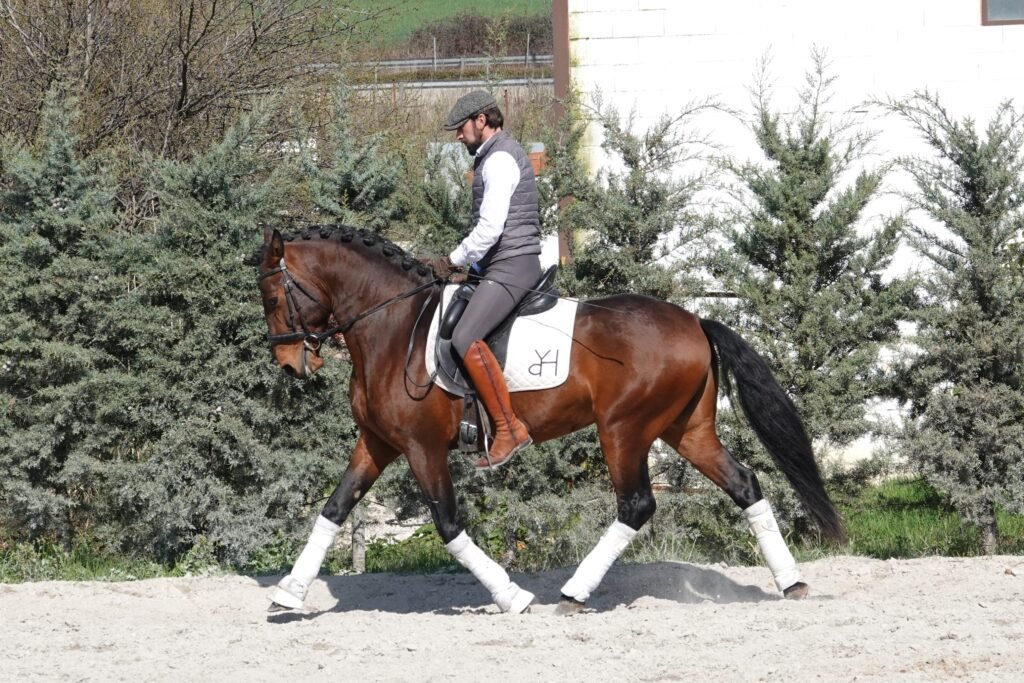
Who Should Buy a 4-Year-Old Horse?
A 4-year-old Iberian horse is the right choice for three types of buyers: experienced riders who want to develop a horse to their own style, amateur riders with serious long-term goals in Classical Dressage or Working Equitation, and professionals looking for a horse with exceptional raw material at an accessible price point.
What all three have in common is a long-term mindset. A 4-year-old is not a horse you compete in six months. It is a horse you build over years — and that process, when done correctly, produces a partnership and a level of performance that a ready-made horse rarely matches.
The most important quality in a buyer of a young horse is not technical skill. It is the willingness to invest time. Those who do, consistently report that the bond formed with a horse they developed from the beginning is unlike anything a ready-made horse can offer.
What Are the Real Advantages of Buying a 4-Year-Old Horse?
The first advantage is one that experienced buyers understand immediately: price. A well-bred 4-year-old Iberian horse with exceptional movement and verified bloodlines costs a fraction of what that same horse will be worth at eight or nine years old with a competition record behind him. You are not buying a cheaper horse. You are buying the same horse — earlier.
The second advantage is formation. A horse that learns from you from the beginning absorbs your rhythm, your aids, your way of communicating. That is not something you can retrofit into a horse shaped by other hands. It is built, slowly, through hundreds of hours of quiet, consistent work — and the result is a responsiveness and harmony that riders of older horses often spend years trying to find.
The third advantage is time. A 4-year-old has his whole sporting life ahead of him. A body that has not been overworked. Joints that have not absorbed years of competition stress. If you manage his development with care and without rushing, you are not just buying a horse — you are building something that will last.
And then there is something that no spreadsheet captures but every serious horseperson knows. In 24 years working with Lusitano and PRE horses, I have seen it over and over again. The riders who bring a young horse along from the beginning do not just end up with a well-trained horse. They end up with a horse that genuinely knows them — their energy, their uncertainty, their good days and the difficult ones. That connection is not something you find. It is something you build. And once you have it, you understand why some people will never go back to buying an older horse.
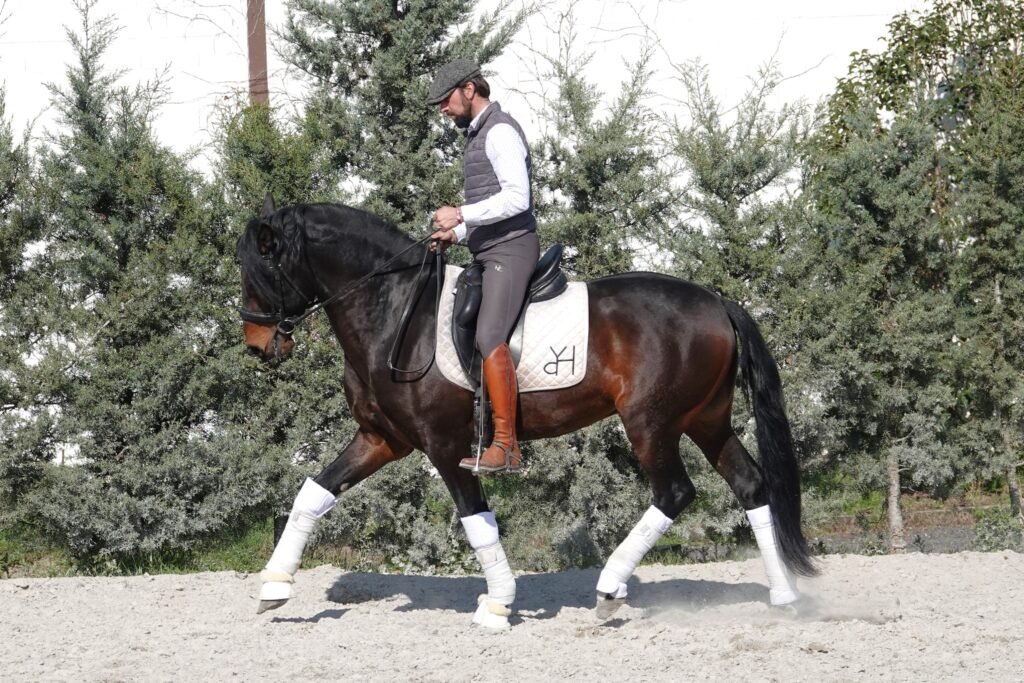
How Should a 4-Year-Old Horse Be Worked — And How Should It Not?
The first thing I tell every buyer of a young horse is this: the biggest mistake is not doing too little. It is doing too much, too soon.
At four years old, a horse’s body is still developing. His muscles, his joints, his back — none of them are ready for the demands we place on a horse of seven or eight. But more than the physical side, it is the mental side that people underestimate. A young horse tires in his mind long before he tires in his legs. Short sessions — honest, calm, with a clear end when things go well — build more than long ones ever will.
Variety matters more than people think. The horse that only sees a dressage arena becomes a horse that only knows a dressage arena. Hacking out, ground work, quiet time in the field — all of it contributes to a balanced, confident horse. The best-trained horses I have known in my career were not the ones that spent the most hours in the arena. They were the ones that lived the most complete lives outside of it.
Collection should never be forced at this age. The Iberian horse has a natural tendency toward collection — it is in his blood, in his conformation, in the way he moves. But asking for it before the musculature is ready does not accelerate development. It damages it. The Iberian horse will offer you collection when he is ready. Your job is not to ask for it before that moment. Your job is to prepare the body and the mind so that when it comes, it comes naturally — and lasts.
Stability is everything. Same rider, same routine, same environment as much as possible. A young horse learns through repetition and trust. Every unnecessary change — a new trainer, a new stable, a new set of hands — costs time that you will spend rebuilding what was already there.
In 24 years I have seen young horses ruined not by bad intentions but by impatience. Competition pressure before the horse is ready, sessions driven by the rider’s frustration, too many changes of hands in those first critical years. A 4-year-old does not need to prove anything yet. He needs time, consistency, and someone who trusts the process enough to protect it.
Why a 4-Year-Old Iberian Horse Is Perfect for Working Equitation
Working Equitation is not a new discipline. It is the recovery of something very old — the way the Iberian horseman has always worked with his horse. And when you understand that history, it becomes clear why the Lusitano is not just suitable for Working Equitation. He was bred for it.
The Lusitano comes from a tradition of real work. Rejoneo, bull herding, the classical Portuguese equitation — all of it demanded a horse with a naturally ground-covering walk, a balanced and controllable canter, quick reflexes, and above all a calm, thinking temperament. Those qualities were not trained into the breed. They were selected over centuries. They are in the blood.
The PRE is a magnificent horse. But if I am honest — and after 24 years I can afford to be — the Lusitano brings something extra to Working Equitation. A deeper connection to the work itself. A naturalness in collection and lateral movement that makes the obstacles feel less like a test and more like a conversation between horse and rider.
Starting a Lusitano in Working Equitation at four years old is not a compromise. It is a strategy. The discipline rewards exactly what a young Iberian horse already has — walk, canter, trainability and temperament. You are not asking him to learn something foreign. You are asking him to do what his bloodline has always done. In my experience, those are the horses that surprise you most — not because they were pushed, but because they were finally allowed to be themselves.
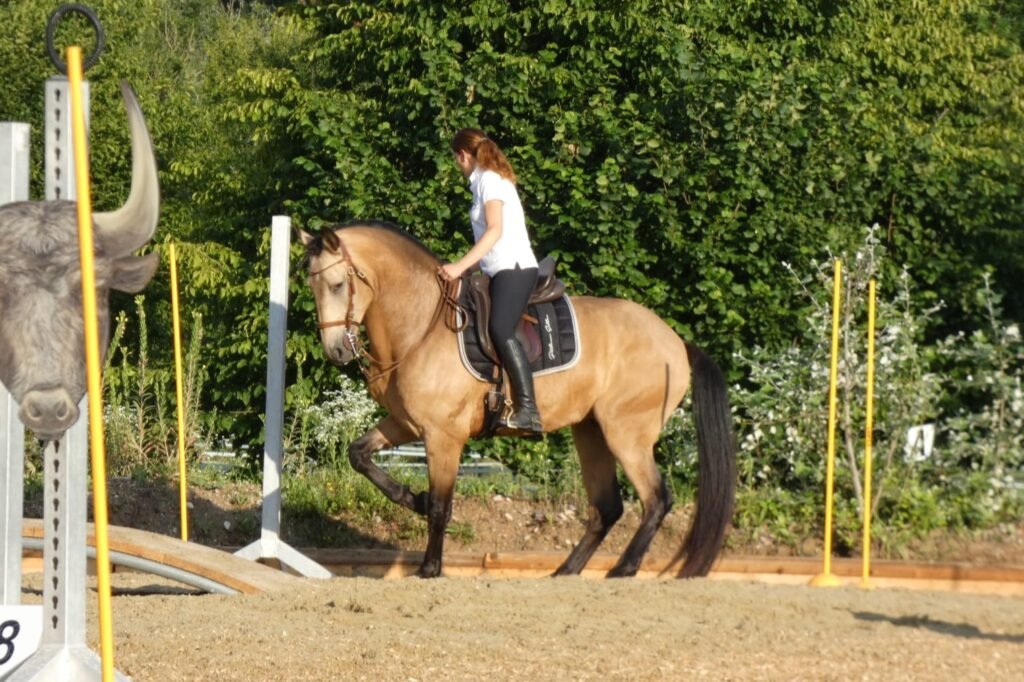
What a 4-Year-Old Iberian Horse Should Already Show
There is a question I hear often from serious buyers: how do I know if a 4-year-old horse has real potential, or if I am just buying hope?
It is a fair question. And after 24 years, my answer is always the same: you look at what the horse already gives you without being asked.
At four years old, a well-bred Iberian horse should already show a walk that covers ground naturally — not a shuffle, not a hurried step, but a genuine four-beat rhythm that oversteps the forefoot print without effort. That quality cannot be trained. It is either there or it is not. And when it is there, everything built on top of it — collection, lateral work, Working Equitation — becomes a different conversation entirely.
The canter should feel balanced and natural, not forced or tense. A young Iberian horse with good canter is already telling you something important about his future. It is the gait that reveals the most about a horse’s scope, his back, and his willingness to carry.
Beyond movement, you are looking at character. A 4-year-old that is calm leaving the stable, curious in new environments, and responsive without being reactive — that horse will give you years. In my experience, character at four years old is the most reliable predictor of what a horse will become. Movement can be refined. Character is what it is from the beginning.
Good bloodlines matter. But bloodlines without character and movement are just paperwork. What you are looking for at four years old is simple: a horse that already feels like something. You will know it when you sit on him.
And if you have never had the opportunity to sit on one to feel what a well-bred Iberian horse actually gives you that experience is closer than you think. iberianequineexperience.com
The Horse You Build Is the Horse You Keep
Buying a 4-year-old Iberian horse is not the easy path. It asks more of you — more time, more patience, more trust in a process that does not show results overnight. But in 24 years of working with Lusitano and PRE horses, I have never met a rider who regretted it.
What you build with a young horse is yours in a way that nothing else in this sport is. The response to your leg, the softness in your hand, the calm in a new environment — none of that arrived ready-made. You created it, together, one session at a time.
If you are considering a young Iberian horse and want honest advice — about bloodlines, about training, about whether a specific horse is right for you — we are at APM Iberian Horses in northern Spain, and we have been having that conversation for 24 years.
View our available horses at apmiberianhorses.com